
Setup 101: Rear End and Tyres
Connecting the power to the ground—a guide to T-plates, motor pods, and rear suspension tuning.

In our previous guide, we looked at how the front end of your Mini-Z handles steering and stability. But in a rear-wheel-drive (RWD) car, the back end is where the magic—and the frustration—happens. The rear suspension is responsible for putting the power of the motor onto the track surface without causing the car to spin out.
If your car “oversteers” (the back end slides out) or feels “loose” under acceleration, the solution is usually found in the rear end. In this guide, we will break down the three most important rear tuning tools: T-plates, motor pods, and dampers.
The T-Plate: Your Primary Rear Suspension
The most distinctive feature of the Mini-Z RWD chassis is the T-plate. This T-shaped piece of plastic, fiberglass, or carbon fibre connects the motor pod to the main chassis. It acts as the car’s primary rear spring, allowing the rear axle to move up and down (pitch) and side-to-side (roll).
How it works: T-plates come in different thicknesses and materials, usually rated on a scale (e.g., #1 to #6 or Soft/Medium/Hard).
- Soft T-Plates: These allow more chassis flex. This extra flex helps the rear tyres find grip, making the car much easier to drive on low-traction surfaces.
- Stiff T-Plates: these reduce chassis roll. This makes the car feel more responsive and stable at high speeds, but it can lead to a “snappy” loss of traction if the tyres reach their limit.
The Feel: If your car is spinning out when you accelerate out of a corner, try a softer T-plate. It will make the rear end feel “lazier” but much more predictable. If the car feels like it’s “lazy” and won’t change direction quickly, a stiffer T-plate will sharpen the handling.
Motor Pods: Wheelbase and Balance
The MR-04 (and earlier MR-03) RWD platform is modular, meaning you can swap the rear “pod” that houses the motor and axle. This change affects the car’s wheelbase (the distance between front and rear wheels) and its weight distribution.
1. RM (Rear Mount)
The motor sits behind the rear axle. This is used for short wheelbases (86mm to 94mm).
- The Feel: Because the motor’s weight is hanging off the back, the car has a lot of “pendulum” effect. It tends to oversteer heavily on corner entry but pushes on exit. It is a challenging but fun setup, often used for classic sports car bodies like the Porsche 911.
2. MM / MM2 (Mid Mount)
The motor sits in front of the rear axle. This is the standard for modern racing and supports 94mm and 98mm wheelbases.
- The Feel: This setup centralizes the weight, providing a neutral and balanced feel. It offers the best mix of turn-in and rear stability, making it the go-to for most competitive classes.
3. LM (Le Mans)
A specialized mid-mount pod designed for 102mm wheelbases. It often features a wider rear track.
- The Feel: Widely considered the best-handling configuration. The longer wheelbase and wider track provide incredible high-speed stability. If you want to set a track record, you’re probably driving an LM pod.
Rear Dampers: Controlling the Bounce
To supplement the T-plate, most racers add one or two additional dampening units:
- The Top Shock: This controls the “pitch” (front-to-back) movement of the motor pod. By adding silicone oil to this shock, you can stop the rear end from “pogoing” during hard acceleration or braking.
- Disk Dampers: These are two small plates that sit on top of the motor pod. By applying thick grease between the plates, you can control the “roll” (side-to-side) speed of the rear end.
The Feel: Dampers don’t change how much the car can move; they change how fast it moves. Proper dampening eliminates “chatter”—that annoying high-speed vibration you see when a car hits a small bump. It keeps the rear tyres pressed firmly against the track, ensuring consistent power delivery.
Differentials: Gear vs. Ball
Finally, we have the differential. This allows the two rear wheels to spin at different speeds, which is essential for cornering.
- Gear Diff (Stock): Durable and maintenance-free, but it can “unload” power to the inside wheel during a corner, causing a loss of traction.
- Ball Diff (Upgrade): Allows you to adjust how much the wheels are allowed to slip. By tightening or loosening the diff, you can tune the car’s “drive” out of corners. It requires regular maintenance but is a must-have for serious racing.
Bringing it All Together: Tyres and Balance
The rear end is only half the story. As we discussed in our Tyre Guide, your rear tyres must complement your rear suspension setup.
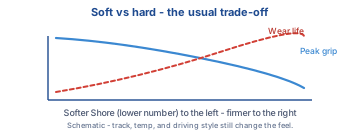
A common beginner mistake is to put the softest possible tyres on a car with the stiffest possible T-plate. This creates a car that is “stuck” to the track until it suddenly isn’t, leading to spectacular crashes. The goal is balance.
The Golden Rule of Rear Setup: Start with a neutral setup (MM pod, medium T-plate, 20-shore radial tyres). If the car has too much grip (traction rolling), stiffen the T-plate or use a harder rear tyre. If the car has too little grip (spinning out), soften the T-plate or move to a softer rear tyre.
By understanding the relationship between the T-plate’s flex, the motor pod’s weight distribution, and the tyre’s grip, you can transform your Mini-Z from a “slideway specialist” into a precision racing machine.
This concludes our Setup 101 series. Now, there’s only one thing left to do: get out on the track and start testing!